Last updated on May 24, 2026
Buying from Japan is more accessible than it used to be, but it can still feel confusing once you look beyond the product price.
Maybe you found an anime figure, a TCG item, a manga set, a retro game, or a limited collaboration that is only available in a Japanese store. The listing looks good. The price seems fair. But then the real questions start:
- Will the store ship outside Japan?
- How much will domestic shipping cost?
- What will international shipping look like?
- Can this item be shipped by Japan Post?
- Will import taxes apply in my country?
- Does this purchase still make sense after all costs are included?
This is where a Japanese proxy service can help.
A good proxy service should do more than buy an item on your behalf. It should help you understand the process before you decide, so you can look at the full picture: item cost, service fees, shipping options, packaging, restrictions, possible import charges, and timing.
In this guide, we will explain how Japanese proxy services work in 2026, what costs to check before buying, how shipping estimates can help, how Wallet balance may fit into eligible payments, and when importing from Japan may not be the best option.
1. What is a Japanese proxy service?
A Japanese proxy service acts as your representative in Japan.
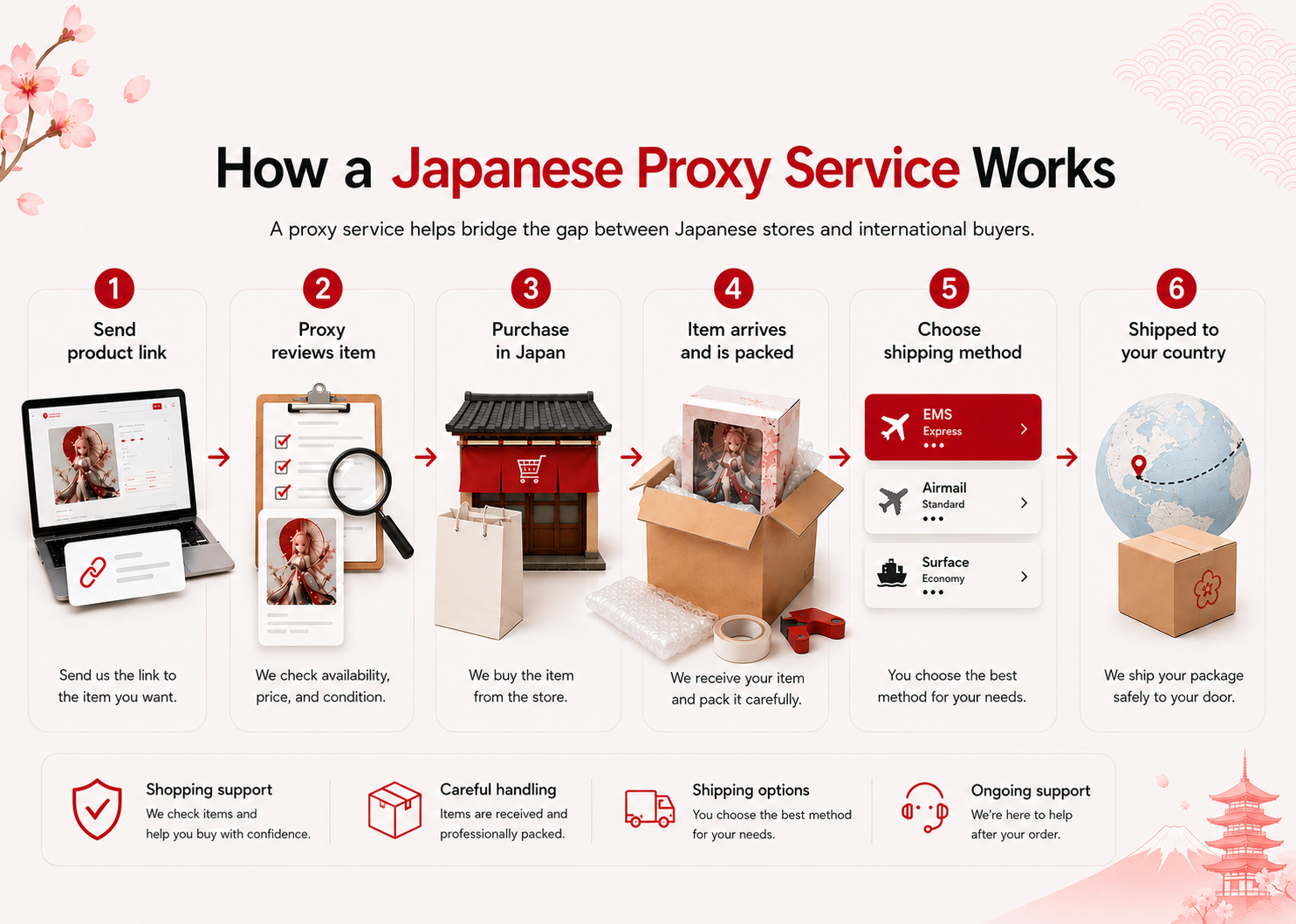
Instead of buying directly from a Japanese store yourself, you send the product link to the proxy service. The proxy reviews the item, confirms key details, buys it in Japan when possible, receives it at a Japanese address, prepares the package, and helps arrange international shipping to your destination.
The basic flow usually looks like this:
- You find an item on a Japanese store or marketplace.
- You send the product link to the proxy service.
- The proxy reviews details such as item name, price, quantity, condition, domestic shipping, and possible restrictions.
- You confirm the order and complete the first payment.
- The proxy buys the item in Japan.
- The item arrives at the proxy warehouse.
- The item is received, checked, measured, and weighed.
- You choose an available international shipping method.
- The package is shipped to your address, with tracking when available for the selected method.
This is useful when a Japanese shop does not ship internationally, does not accept overseas payment methods, or has a checkout process that is difficult to use from outside Japan.
For beginners, the biggest benefit is not only access. It is guidance. A proxy service can help you understand what happens between “I found this item” and “the package is on its way.”
To learn more about the full order flow, you can also read how our
proxy buying process works.
2. Why Japanese proxy services matter more in 2026
In 2026, buying from Japan is not just about finding an item. It is about understanding the full cost and the practical risks before you commit.
More international buyers are looking for Japanese anime figures, trading cards, manga, retro games, fashion collaborations, event goods, and limited-edition collectibles. More listings are shared in collector communities, social media posts, and hobby groups.
That creates more opportunity, but also more confusion.
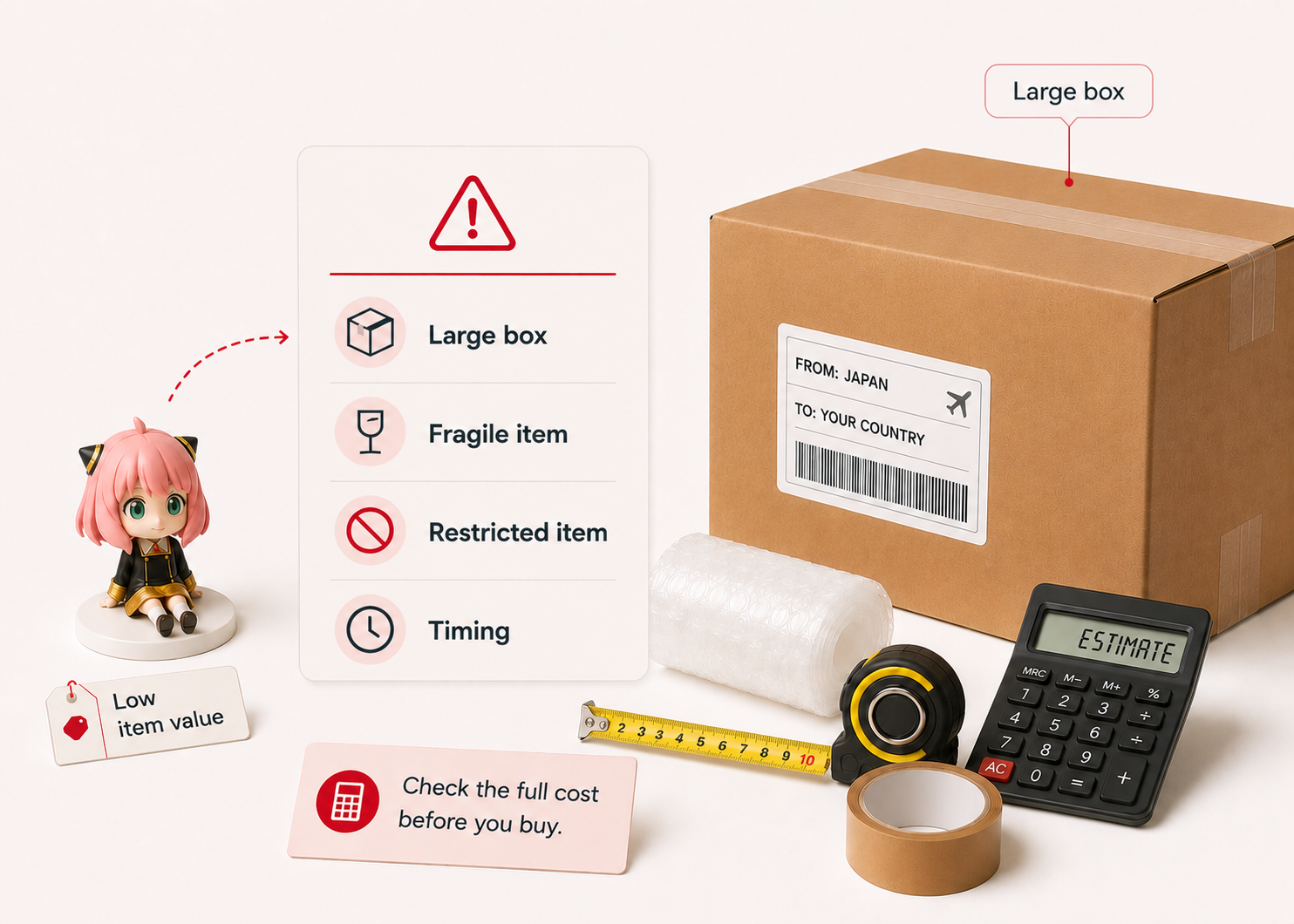
An item may look affordable at first. But the final cost can change once you add domestic shipping, proxy fees, international postage, packaging, payment fees, and possible import charges in your country.
A figure that seems like a good deal may become less attractive if the box is large, the shipping method is limited, or the item needs extra care during packing.
Exchange rates can also affect how attractive a purchase looks from overseas, but they should not be the only factor. A lower item price does not automatically mean a better total purchase scenario.
The question is not only:
“Can I buy this from Japan?”
The better question is:
“Does this purchase still make sense after I understand the full cost, shipping options, timing, and risks?”
That is why clarity matters.
3. Understanding the cost of buying from Japan: two payment stages
One of the easiest mistakes when buying from Japan is looking only at the product price.
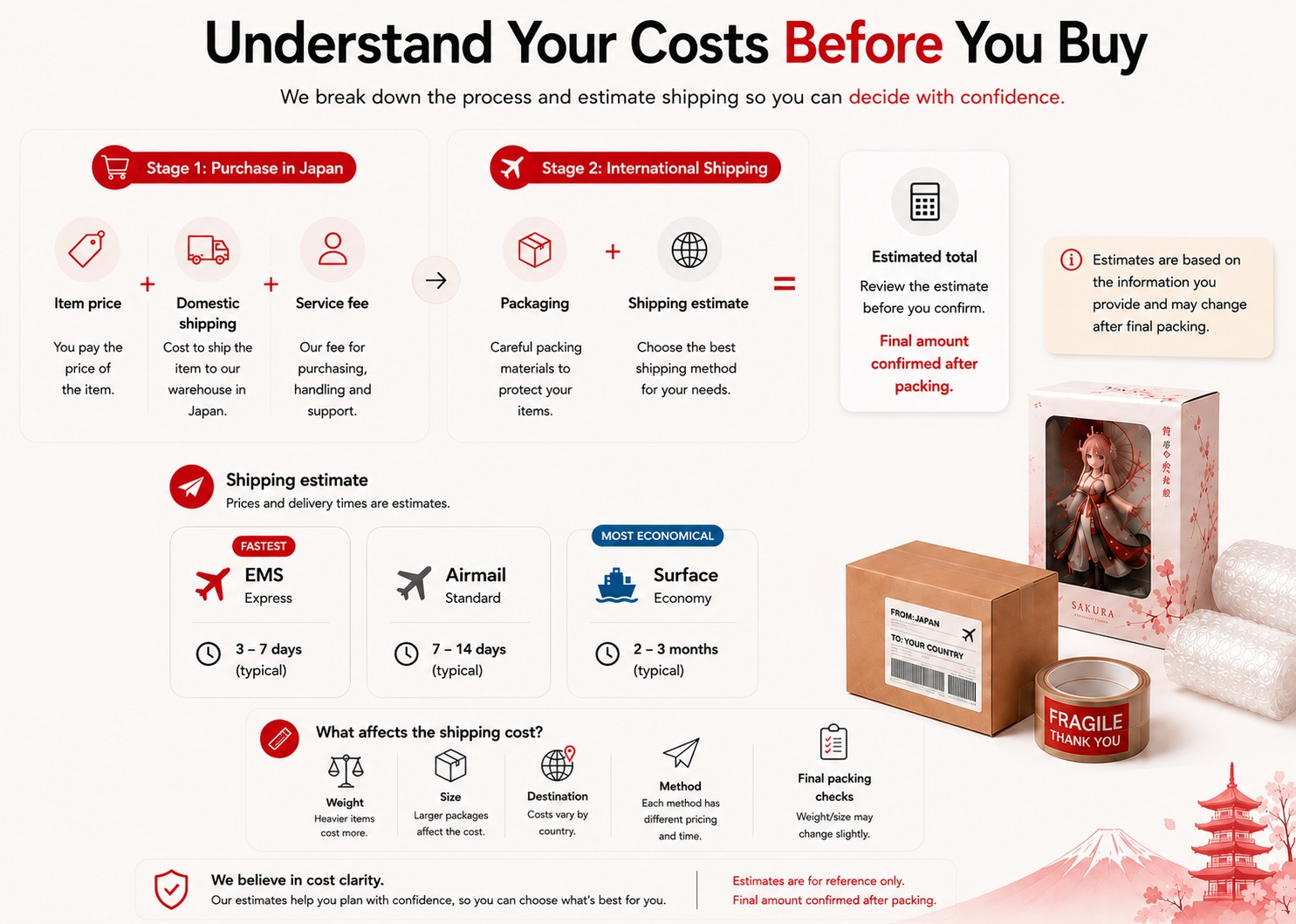
In most proxy buying flows, the total cost is split into two main stages: the purchase in Japan and the international shipment.
Stage one: purchasing in Japan
The first stage covers the cost of buying the item inside Japan. This may include:
- the product price;
- Negai Japan’s service fee;
- domestic shipping within Japan, when applicable;
- payment processing fees.
This is the stage that allows the proxy to purchase the item from the Japanese store or marketplace and have it sent to the proxy warehouse.
Stage two: international shipping
The second stage happens after the item arrives at the warehouse, is received, and can be prepared for international shipping.
This stage may include:
- international postage;
- packaging materials;
- optional extra services, when selected;
- payment processing fees.
Import taxes, customs duties, handling fees, and local charges from the destination country are not included in Negai Japan’s shipping estimates and remain the customer’s responsibility.
Example cost breakdown
Here is a simplified example of how the total can be built:
- Product price: ¥3,000
- Service fee: ¥240
- Domestic shipping in Japan: ¥600
- Packaging materials: ¥400
- International shipping estimate: ¥2,200
Estimated total before import taxes and local charges: ¥6,440
This is only an example. Final values depend on the item price, domestic shipping charged by the seller, package weight, package dimensions, destination country, available shipping methods, optional services, and applicable payment fees.
That is why the safest way to think about proxy buying is not “item price only.” It is the full purchase scenario.
4. How shipping estimates help before you buy
Shipping is often the part that makes international buyers hesitate.
You may know the product price, but still wonder:
- How much could international shipping cost?
- Which Japan Post methods may be available?
- Is the item light enough for a smaller shipping method?
- Will the box size change the estimate?
- Should I buy now, consolidate later, or skip this item?
Negai Japan’s
Cost Calculator, was created to help with this decision.
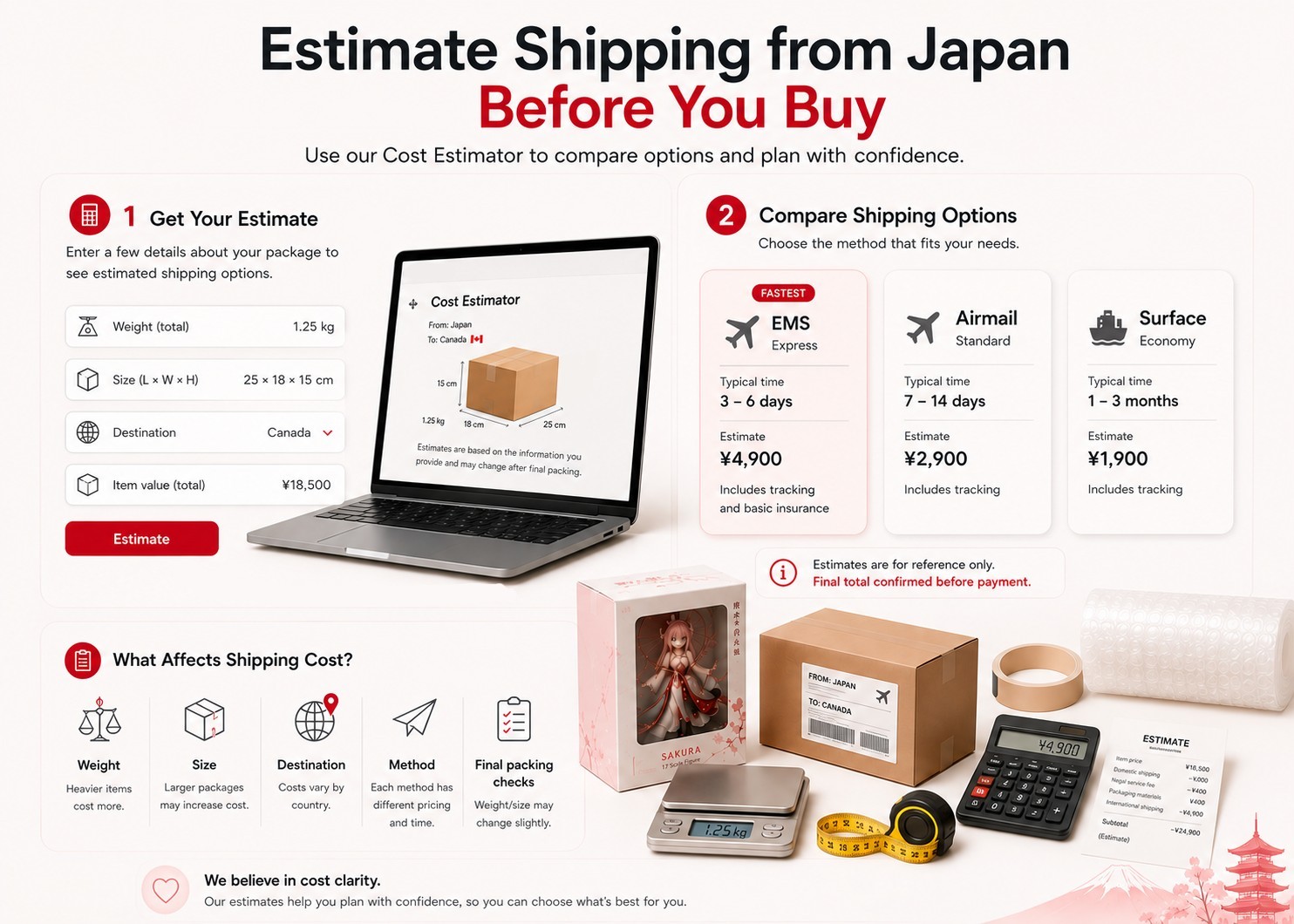
It gives you an estimated shipping scenario before you commit to a purchase. You can use it to compare available Japan Post methods based on destination, package weight, item value, and, in the more detailed estimate, package dimensions and optional services.
Quick Estimate
The Quick Estimate is useful when you want a fast reference. You enter the destination country, estimated package weight, and item value. The calculator then displays eligible shipping methods with estimated prices and typical delivery times, when available.
Precise Estimate
The Precise Estimate gives you more control. You can enter package dimensions, weight, item value, domestic shipping in Japan, and optional extras.
This can be especially useful for figures, box sets, books, or items that may become bulky once they are properly packed.
What the Cost Calculator includes
Depending on the estimate type and selected options, the calculator may include:
- international postage based on Japan Post methods;
- packaging materials;
- payment processing fees;
- selected optional extras in the detailed estimate.
What the Cost Calculator does not include
The estimate does not include:
- customs duties;
- import taxes;
- handling fees charged in the destination country;
- local charges after arrival;
- costs related to items that cannot be shipped by the selected method.
Shipping estimates are for reference. The final amount is confirmed after the item arrives, the package is measured and weighed, and the available methods are checked for your destination.
Before buying, you can use the
Cost Calculator to compare your options and decide whether the order still makes sense.
5. Wallet balance: how it can make eligible payments easier
Negai Japan Wallet is an internal account balance feature that helps you track eligible balance, eligible refunds, and eligible Wallet-funded payments inside your account.
When available, Wallet can make some parts of the payment flow easier because eligible amounts can be managed inside your Negai Japan account.
For example, if an eligible refund is returned to your Wallet, you may be able to use that eligible balance for a future Wallet-funded payment, subject to the applicable policies at the time.
Your Wallet transaction history can also help you understand account activity such as credits, debits, and eligible refunds.
Wallet is not a bank account, investment product, currency exchange service, or a way to avoid taxes, customs duties, shipping fees, or payment fees. It is an internal account balance feature designed for eligible activity within Negai Japan.
Any Wallet use, eligible refund, eligible balance, or Wallet-funded payment remains subject to Negai Japan’s applicable policies.
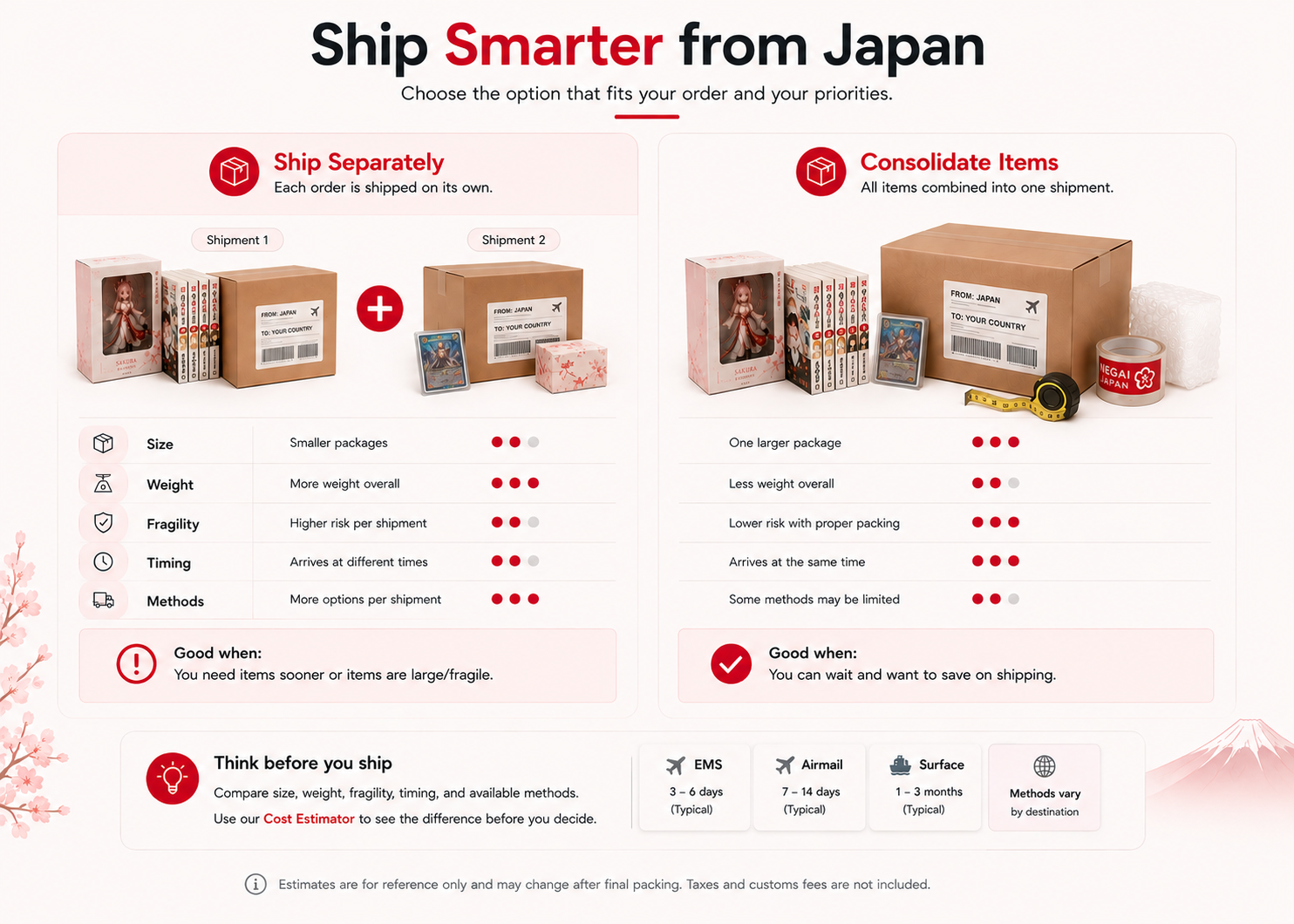
6. Consolidation: when combining packages may help
Consolidation means combining multiple items or packages into one international shipment.
This can be useful when you buy several small items from Japan and want to ship them together instead of paying for multiple international parcels.
However, consolidation is not always the cheapest or safest choice. It depends on what you bought, how large the final package becomes, how fragile the items are, which shipping methods remain available, and what rules apply in your destination country.
When consolidation may make sense
Consolidation may be helpful when you are shipping:
- multiple small anime goods;
- manga volumes or books;
- small figures;
- TCG products;
- CDs, acrylic stands, keychains, or other lightweight goods.
In some cases, combining items into one shipment may reduce repeated shipping costs or make tracking easier.
For a deeper look at this topic, read our guide on
consolidation and international shipping.
When separating shipments may be better
Consolidation may not be the best choice when:
- items are fragile and need different packing approaches;
- one item is much larger than the others;
- the final box becomes too heavy or bulky;
- combining items removes access to a smaller shipping method;
- customs rules in the destination country make separate shipments more practical;
- one item is urgent while the others are not ready yet.
The goal is not to always consolidate. The goal is to choose the option that makes the most sense for your package, destination, timing, and risk tolerance.
7. Restricted items and shipping eligibility
Not every item can be shipped internationally by every method.
Some products may be restricted because of their contents, materials, batteries, liquids, sprays, magnets, size, destination rules, or postal limitations.
In some cases, an item may be shippable only by certain methods. In other cases, it may not be eligible for international shipping.
This is especially important before buying items such as:
- products with lithium batteries;
- aerosols or sprays;
- paints or chemical products;
- certain cosmetics;
- magnets;
- fragile resin items;
- oversized goods;
- items with unclear contents or incomplete product information.
Checking shipping eligibility before purchase can reduce avoidable problems, but eligibility still depends on item details, destination rules, and available postal methods.
If a shipping method is not available for your item or route, you may need to choose another method, adjust the order, or reconsider the purchase.
This is one reason why clarity before buying matters. A good proxy service should help you identify possible issues before they become expensive problems.
8. Scalpers, resale prices, and timing
Many Japanese collectibles become more expensive when demand rises.
This can happen with limited anime figures, event goods, trading cards, collaboration items, concert goods, game merchandise, and products that are no longer available at retail price.
Sometimes the higher price reflects scarcity, condition, rarity, or collector demand. Other times, the price may be inflated by resellers who buy limited items and list them later at a markup.
A proxy service does not automatically guarantee that you will avoid inflated prices. You still need to check the listing carefully.
Before buying, it helps to compare:
- the original retail price, when available;
- current Japanese marketplace prices;
- international resale prices;
- domestic shipping in Japan;
- estimated international shipping;
- possible import taxes and local charges;
- the condition of the item and box.
You may reduce the risk of overpaying by comparing the Japanese price, the international resale price, and the estimated total cost before you buy.
Timing also matters. Buying during peak hype can be expensive. In some cases, waiting for a restock, preorder, official re-release, or calmer resale period may be better. In other cases, a rare item may become harder to find later.
The right decision depends on the item, your budget, and how much risk you are comfortable with.
9. How to choose a Japanese proxy service in 2026
There are many ways to buy from Japan, but not every service is built for the same type of buyer.
Some buyers want the fastest possible checkout. Some want the lowest possible fee. Others need more guidance because they are buying a fragile figure, using a proxy service for the first time, or trying to understand whether the total cost makes sense.
If you are choosing a Japanese proxy service in 2026, here are the questions worth asking.
Does the proxy explain costs clearly?
You should be able to understand the difference between product price, service fee, domestic shipping, international postage, packaging, optional services, payment fees, and import charges.
If the cost structure is unclear, the item price alone may give you the wrong impression.
Can you estimate shipping before buying?
A shipping estimate is not a final quote, but it can help you avoid making decisions blindly.
For collectors, this is especially useful when the item may be large, fragile, boxed, or heavier than expected.
Does the proxy check shipping eligibility?
Before buying, it helps to know whether the item may have restrictions or whether your preferred shipping method may not be available.
This is important for items with batteries, sprays, liquids, paints, magnets, oversized packaging, or unclear contents.
Does the proxy offer support?
Automation is useful, but some purchases still need human judgment.
If you are buying a used figure, a limited item, a fragile collectible, or something from a Japanese listing you do not fully understand, support can make the process less stressful.
Does the proxy understand collectibles?
Anime figures, TCG products, manga sets, acrylic goods, and limited merchandise are not just “random items.”
Collectors often care about box condition, item condition, missing parts, blister damage, seller notes, and packaging choices. A proxy service that understands this context can help you ask better questions before buying.
Will the proxy tell you when importing may not make sense?
Sometimes the most helpful answer is not “yes, buy it.”
If the item is too cheap compared with the shipping cost, too fragile, restricted, oversized, or available locally for a similar total price, importing may not be the best choice.
A clear proxy service should help you decide, not pressure you to buy.
10. When importing from Japan may not make sense
Buying from Japan can be exciting, but it is not always the right choice for every item.
Here are situations where you may want to pause before placing an order.
The item price is low, but shipping is high
A low product price does not always mean a good deal. If the item is inexpensive but international shipping is high, the final cost may not be worth it.
This often happens with small low-value goods, single books, or items that are cheap in Japan but costly to ship alone.
The item is fragile or oversized
Large figures, resin items, framed goods, glass items, or products with delicate packaging may require extra care. More protection can also increase package size and weight.
In these cases, the safest option may not be the cheapest one.
The item may be restricted
If a product contains batteries, sprays, liquids, paints, chemicals, magnets, or unclear components, it may have shipping limitations.
It is better to check before buying than to discover after purchase that the item cannot be shipped by your preferred method.
The timing does not work for you
Some methods may take longer than others. If you need an item by a fixed date, international shipping may not be predictable enough.
Typical delivery times are useful for planning, but they are not guaranteed delivery dates.
The resale price is inflated by hype
When a product is trending, prices may rise quickly. Buying immediately is not always wrong, but it is worth comparing prices before deciding.
Sometimes waiting is better. Sometimes buying sooner is better. The important thing is to understand the tradeoff.
11. Conclusion: clarity is the real advantage
Japanese proxy services can make it possible to access products that are difficult to buy directly from outside Japan.
But in 2026, access alone is not enough.
You also need to understand the full cost, available shipping methods, packaging needs, possible restrictions, import responsibilities, Wallet balance when applicable, and the risk of overpaying during hype cycles.
At Negai Japan, our goal is to help you buy from Japan with more clarity. That means showing the steps, explaining the costs, helping you estimate shipping, and being honest when a purchase may not make sense.
Before you buy, you can use the Negai Japan Cost Calculator to estimate your shipping scenario. Then, if the estimate still looks reasonable for your situation, submit your item link and we will help you review the next step.
Estimate your shipping before you buy.
Use the Cost Calculator
Already have an item in mind?
Submit your item link and start your order with clarity.
FAQ
What is a Japanese proxy service?
A Japanese proxy service helps international buyers purchase items from Japanese stores or marketplaces that may not ship directly overseas. The proxy buys the item in Japan, receives it at a Japanese address, prepares the package, and helps arrange international shipping.
How much does a Japanese proxy service cost?
The total cost usually includes the item price, proxy service fee, domestic shipping in Japan when applicable, international shipping, packaging materials, optional extra services, and payment processing fees. Import taxes, customs duties, handling fees, and local charges are not included and remain the customer’s responsibility.
Can I estimate shipping from Japan before buying?
Yes. With Negai Japan, you can use the Cost Calculator to estimate available Japan Post methods based on destination, weight, item value, and, in the Precise Estimate, package dimensions and selected extras.
Are customs duties or import taxes included?
No. Customs duties, import taxes, handling fees, and local charges are not included in Negai Japan’s estimates. These costs depend on the destination country and are the customer’s responsibility.
Is consolidation always cheaper?
No. Consolidation may reduce costs in some cases, especially with multiple lightweight items, but it can also increase package size, weight, or risk. The best option depends on the items, destination, available shipping methods, and your priorities.
Can all Japanese items be shipped internationally?
No. Some items may be restricted by postal rules, destination rules, or item contents. Shipping eligibility depends on the product, route, and available method.
What is the Negai Japan Wallet?
The Negai Japan Wallet is an internal account balance feature that helps you track eligible balance, eligible refunds, and eligible Wallet-funded payments inside your account, subject to applicable policies.
Is Wallet a bank account?
No. Wallet is not a bank account, investment product, currency exchange service, or a way to avoid taxes, customs duties, shipping fees, or payment fees. It is an internal account balance feature for eligible activity within your Negai Japan account.
What should I check before buying anime figures from Japan?
Before buying anime figures from Japan, check the item price, condition, seller notes, box condition, domestic shipping, estimated international shipping, package size, possible import taxes, and whether the item is eligible for your preferred shipping method.
 USD
USD BRL
BRL AUD
AUD CAD
CAD EUR
EUR GBP
GBP MXN
MXN



 Facebook
 Youtube
 Instagram